
Cost per metre
Compare total installed cost and cost per metre using explicit material, labour, equipment and logistics inputs.
HAPI Business Case Tool
HAPI makes the full installation system visible: cubic metres, truck journeys, trench geometry, crew duration, logistics, cost and CO2. It asks where the money is really being spent.
Full-system comparison
Pipeline decisions are often made around pipe specification and pipe price. HAPI widens the frame. It compares the conventional installation case with the HydroFoamer case and exposes the assumptions behind trench geometry, production rates, aggregate, foam, labour, access, spoil, schedule and CO2 factors. The result is a decision table, not a sales claim.
HAPI is not a savings claim. It is a disciplined way to make project assumptions visible before people argue about conclusions.
Compare total installed cost and cost per metre using explicit material, labour, equipment and logistics inputs.
Estimate selected aggregate reduction, native backfill use, foam volume and avoided material movement.
Compare excavation, placement, foam application, backfill and production-rate assumptions.
Compare selected cradle-to-site and construction activity indicators within the stated calculation boundary.
Expose pipe diameter, trench geometry, haul distances, disposal assumptions, productivity and local commercial inputs.
Use saved scenarios and exportable outputs to support technical and commercial review.
Example outputs
HAPI separates the value drivers. A project may benefit because materials move less, access becomes simpler, duration falls, emissions fall, or execution risk becomes easier to manage.
Shows how much selected bedding and embedment material may be avoided under the HydroFoamer scenario.
Shows how trench width, volume and spoil handling affect the full installation case.
Shows how haul distance, site access, road burden and transport costs influence remote or constrained projects.
Shows how production assumptions change labour, plant and schedule exposure.
Shows where reduced construction activity may reduce sensitivity to weather, access limits or aggregate supply.
Shows how material and logistics assumptions change selected CO2 indicators within the chosen boundary.
Before / after discipline
The strongest business case is not the largest percentage. It is the one where the project team can see exactly which activities change and which assumptions drive the result.
Selected bedding, embedment, quarry source, haul distance, stockpiling, placement, compaction and spoil assumptions are made explicit.
Foam volume, native backfill use, installation sequence, field checks and handover evidence are compared against the conventional baseline.
Open-trench time, crew duration, access constraints, weather sensitivity and plant movements are treated as project costs, not background noise.
The output should tell the team whether to stop, refine the assumptions, request a technical briefing or move into project-specific qualification.
Enterprise value
HydroFoamer gives partners a route to move beyond product supply into pipeline delivery capability: installation method, measured field control, digital handover and HAPI-supported project qualification.
The strategic question for a pipe manufacturer is simple: how many projects are lost because the installed system is too expensive, too slow or too difficult to execute? A controlled installation method can help partners make more projects feasible and compete on total delivered value: fewer logistics constraints, more installation evidence and a stronger reason to be involved before procurement is frozen.
Enterprise-value outcomes remain partner-specific and depend on market access, qualification, commercial execution, delivery capability and project pipeline.
View enterprise value slide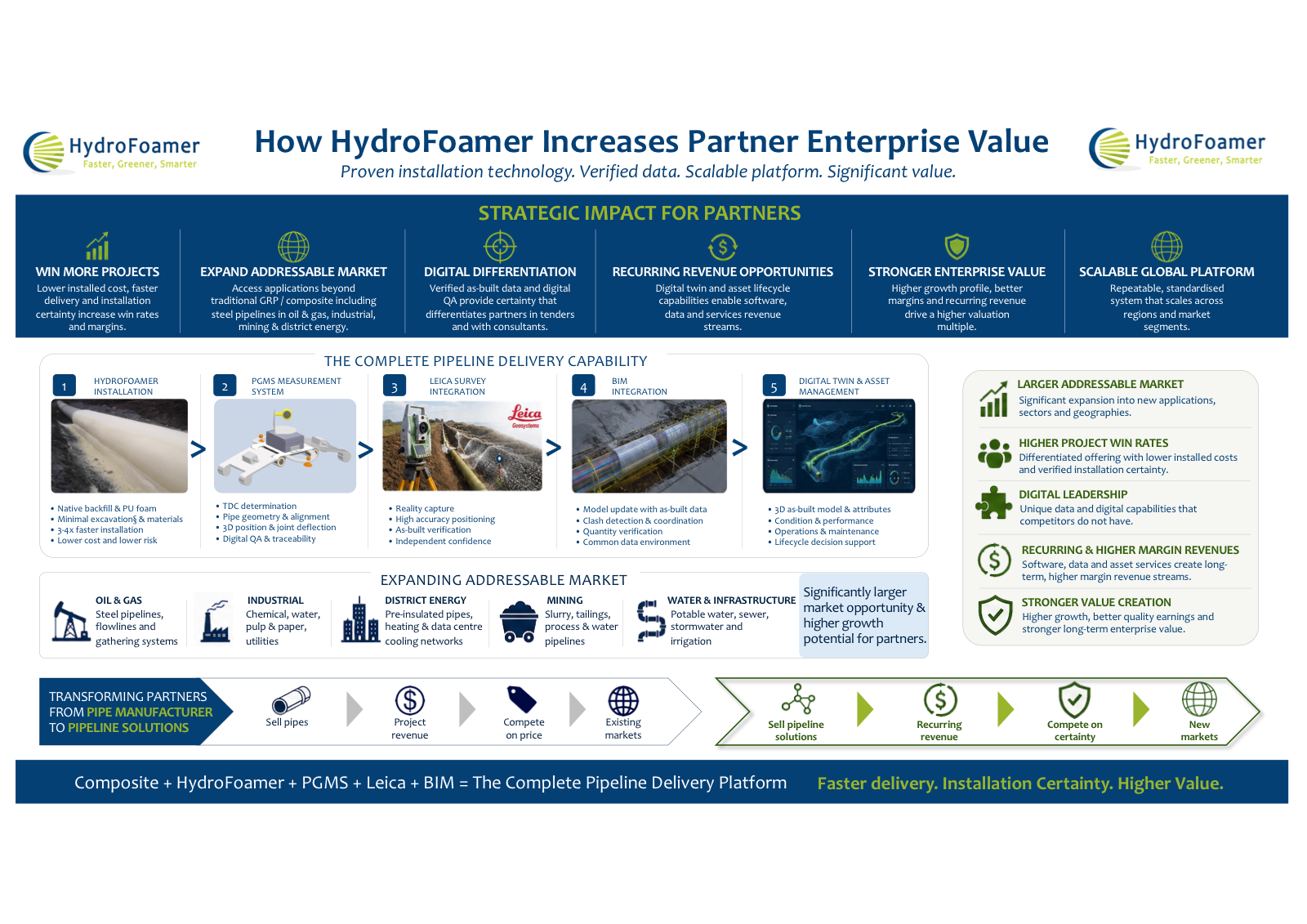
HAPI is normally the first disciplined step. It should create better questions before it creates decisions.
Use HAPI to test whether HydroFoamer merits deeper review for a specific route, pipe and logistics context.
Challenge trench geometry, access, production rates, cost inputs, haul distances and CO2 factors.
Discuss pipe system, installation constraints, evidence requirements and qualification needs.
Share controlled evidence, technical assumptions, partner materials or detailed project data where appropriate.
Review engineering, geotechnical, contractual, procurement and regulatory implications before project decisions.
Assess whether HydroFoamer can be deployed through a credible delivery and partner pathway.
Limitations
HAPI outputs depend on assumptions. They should structure a project-specific conversation, not bypass detailed design, geotechnical analysis, temporary works design, procurement, regulatory approval, method statements, contract pricing or final investment approval.
Start with real project assumptions. The useful output is not a headline saving, but a clearer view of where cost, time, material movement and CO2 originate, and which decision should follow.